
In almost every organization, whether a startup or a sprawling multinational corporation, leadership titles are everywhere… There’s supervisors, managers, directors, VPs, C-this, that, and the other. Yet, despite this sprawl of authority, a consistent and deeply counterproductive misconception continues to persist: that a leader’s duty begins and ends within the confines of ‘their’ functional silo. That a director of finance needs only be concerned with ledgers or a VP of marketing with branding campaigns. Essentially, that a leader’s job is the job, nothing less, and certainly nothing more. This begs the question of where our ethical leadership has gone in enterprises.
Leadership, real and true leadership, is not that narrowly defined.
Leadership is a moral function. It is, at its heart, a human responsibility. And, just like all other human responsibilities, it is ultimately grounded in ethics. Ethics that extend far beyond the title, department, or reporting structure. If you are a leader, your obligation is never just to your function, or even to your direct reports and superiors. Your obligation is to the enterprise as a whole.
The Ethical Shape of Leadership
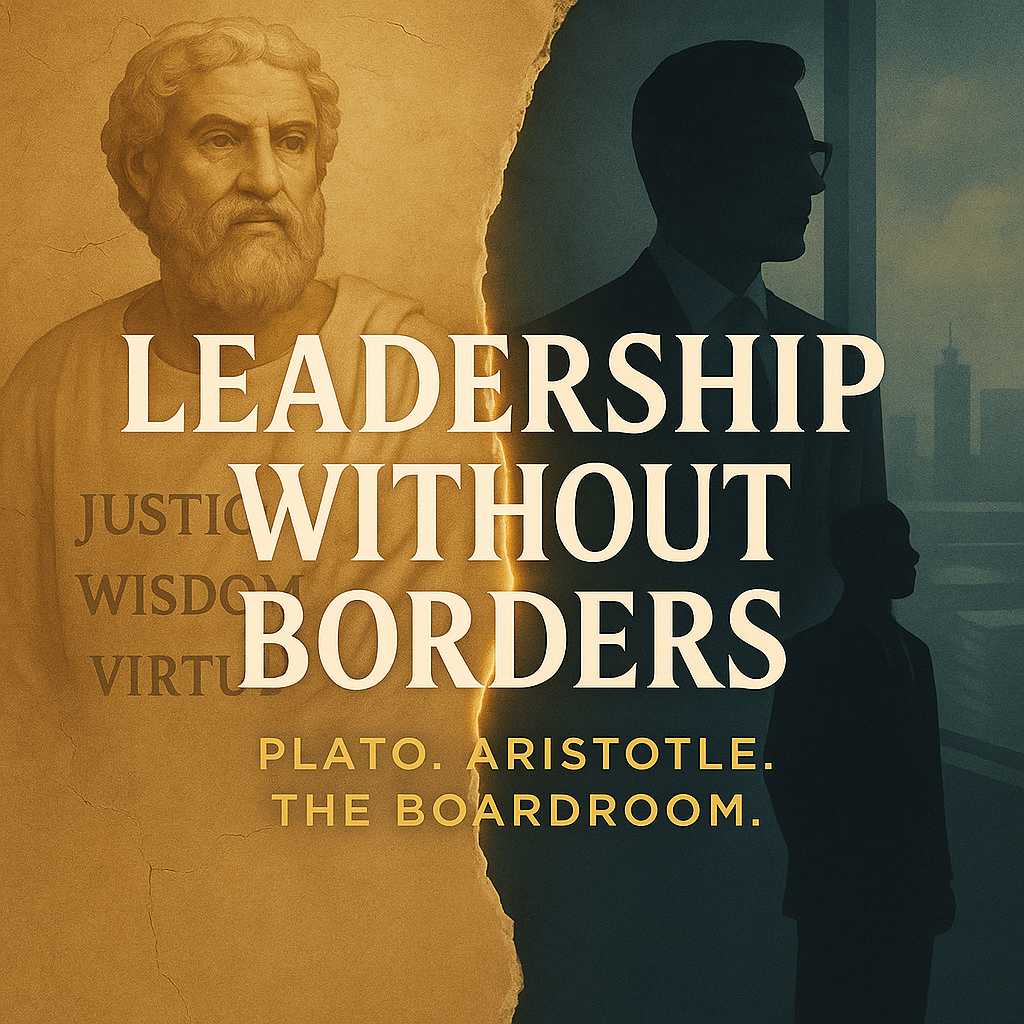
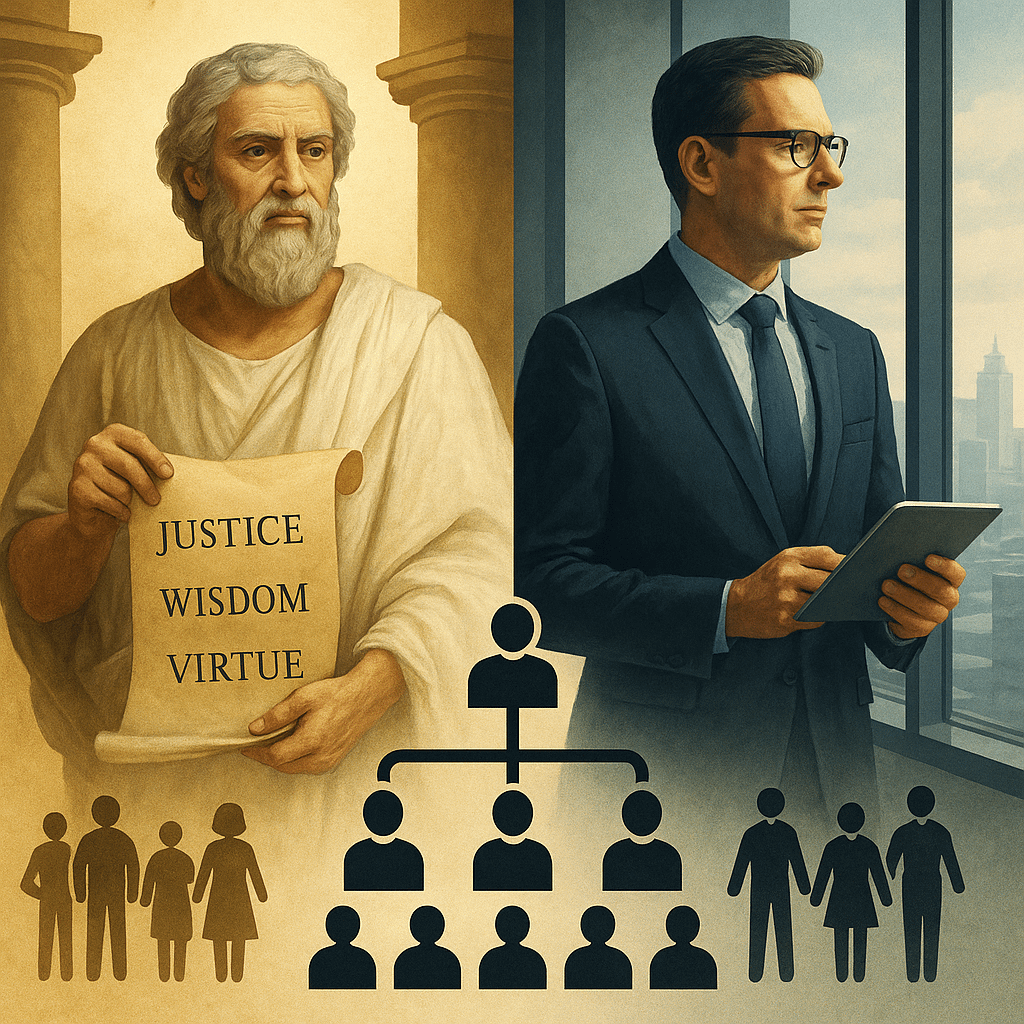
While reading Plato’s The Republic, he paints a picture of leadership with the ‘philosopher-king‘. This is a ruler who governs not for their own benefit, but for the benefit of the entire city-state. Plato’s leader is not chosen because they sought power. They are chosen because they understand truth, justice, and the good. For Plato, leadership should not a reward ambition, it should impose a duty. And most importantly of all, it is a duty to everyone.
I find that principle amazingly relevant in today’s businesses. Leaders within any organization must view themselves as stewards of the whole organization, not just their department, not just their tasks. Whether you oversee IT, Operations, Customer Experience, or Legal, you are never simply managing tasks. Realize it or not, you are providing direction to the business and every department within it. To abandon that duty in favor of divisional or structural isolation is an assault to the very idea of true leadership.
Aristotle goes a bit further by establishing virtue in actions. A leader is not virtuous by what they believe or think, but instead by what they do. Leadership, as I read it, is not just a state of mind, but a way of acting. It is a continuous motivation for the betterment of the whole organization, according to the reason and the principle of human flourishing (Aristotle’s eudaemonia).
In businesses that flourishing goes beyond profits. It includes employees, customers, partners, and shareholders. And, importantly, the betterment of one should never come at the unjustifiable expense of others.
Whom Do Leaders Serve?
Every single person entwined or related to the business. Leaders serve people.
This is true in government, business, the military, communities, everywhere. Leadership is always about people. The question though, especially in business, is: which people exactly?
The answer is horrendously simple: all of them.
Leaders serve employees, whose labor produces the goods or services. The customers, who generate revenue and growth for the business through their purchases and feedback. They serve the company itself: its mission, its values, and its long-term viability and solvency. The shareholders or owners, who have invested their capital with a likely expectation of a return. Ultimately, they serve each other as well. It is the network of leaders who form the functional, practical, and ethical backbone of organizations.
To selectively serve only one group, and particularly if it’s at the expense of the others, is to neglect the obligation of balancing competing needs. To favor only profit over employee well-being, for instance, malnourishes the same organization you claim to lead. And to serve only your own narrow scope is to fail your role entirely.
Escalation Is Not Dissent… It’s Duty
Every day at organizations, problems arise that do not fit squarely within a box on the org chart. You may see toxicity festering in another department. A peer who consistently fails to uphold the company’s values. A policy whose consequences destroy morale or efficiency. And very often, there is a temptation is to say, “That’s not my department,” and just move on.
Leadership requires action. This is not always a direct intervention, but certainly an awareness, concern, and ethical escalation. If those directly responsible fail to act, it becomes your duty to press further, escalate higher, and make the case for change.
Do not read this as to create chaos or overstep. Leaders pursue because they care, because they are invested in the success of the enterprise, not just their small segment of it.
When you ring the alarm bell and raise your concerns, and when you’ve climbed every rung on the ladder only to discover indifference or apathy: do not stop. Because as Plato establishes, justice in a city (or a company) is only possible when each part of the whole works in harmony with the others. Parts out of harmony must be resolved or the city will fall.
So, if correction is needed and those responsible refuse their duties as leaders, then the ethical leader needs to look beyond the internal hierarchy. In the business world, that may mean the Board of Directors, shareholders, or external accountability structures. Because in every enterprise, except the rarest of cases, there will always be someone with a vested interest to demand correction.
And it is never disloyal to seek their help. It is really the ultimate act of loyalty: to the truth, the goals, and ultimately to the organization’s potential.
The Many Leaders of an Enterprise
Not all leaders are executives. And not all people in an organization are leaders, and that’s perfectly okay. Actually, it’s necessary.
Some employees are functionaries. They come to work, perform their specific duties with diligence and skill, and go home. Organizations cannot expect employees to shoulder the burdens of the organization beyond their role. And a business should not charge them with raising alarms or escalating systemic issues (obviously safety and legal are exceptions to this). But crucially, they are not expected to act outside of their assigned responsibilities. Their job is to do the job, and they are quite often the people who keep the business running smoothly, consistently, and precisely.
These employees are no less important than the leaders. In fact, in many cases, they are far more essential to the day-to-day operations and company’s success. But it would be inappropriate, and unfair, to expect them to take on the broader ethical expectations of leadership. That responsibility, that sense of duty to the enterprise as a whole, belongs to leaders because they are entrusted to lead.
Leadership is not a privilege to hold, nor is it a shield from accountability. It should be a voluntary, and often heavy, burden of stewardship. If you accept the title, you’ve accepted the terms: You are now responsible not just for your team or your output. But for the health, ethics, and trajectory of the entire organization.
That’s what separates leaders from workers. It’s not importance, not status, but their scope of obligations.
Ancient Wisdom, Modern Structure
Understanding the responsibilities of leaders and employees becomes clearer when considered in the context of greek philosophy (that’s right, Ancient Greek philosophy makes it simpler!)
This isn’t a modern analysis, the distinction between those who lead and those who execute has existed for ages. Both Plato and Aristotle lay the framework that help us understand not only the roles themselves, but the expectations that are placed upon them.
Plato’s Republic: Rulers and Craftsmen
Plato divides the ideal society into three classes: Rulers, Auxiliaries, and Producers. These are the wise who understand justice and should govern, the enforcers who support the Rulers, and then the skilled laborers that provide for the needs of the city.
All three are present in business, but we’ll focus on two. In business, Leaders (with an ethical obligation to the health of the organization) are Plato’s Rulers. They are expected to go beyond narrow interests and act in service to the organization as a whole.
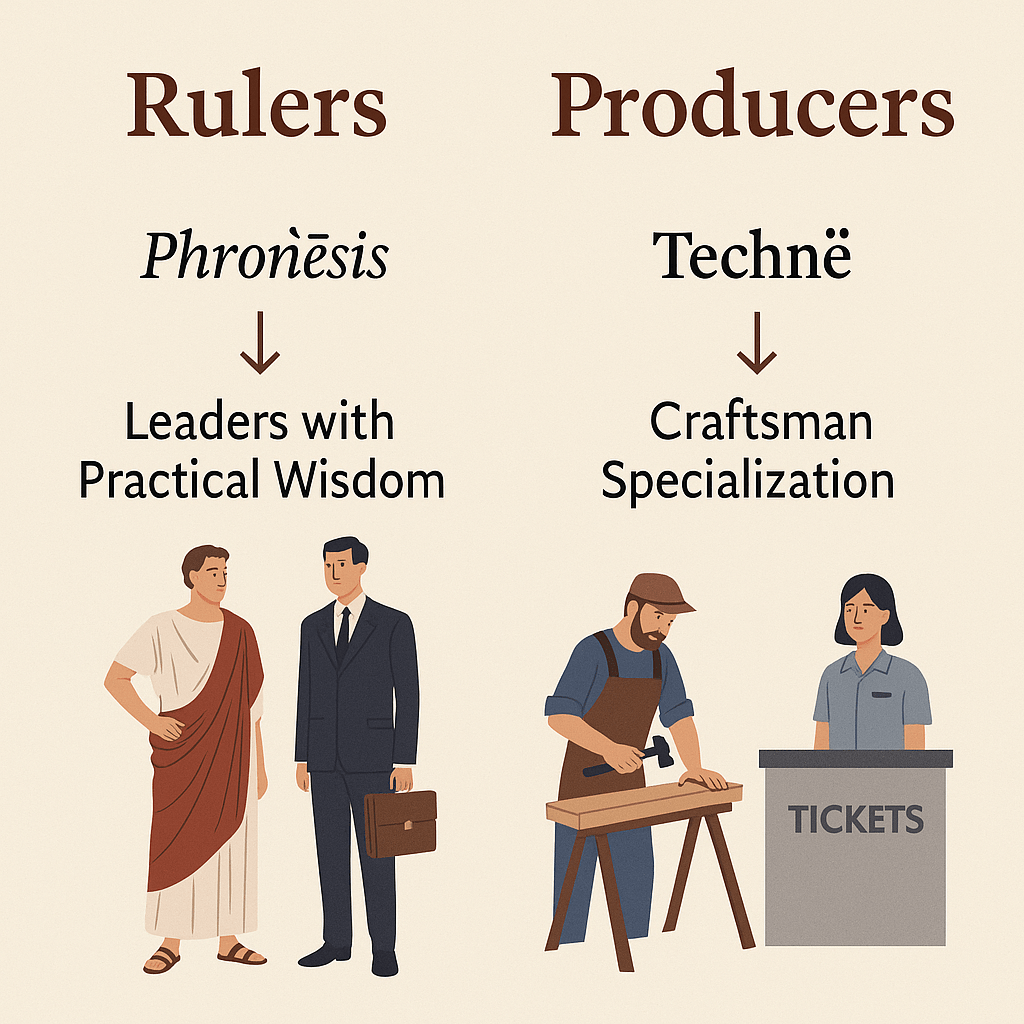
Meanwhile, employees are analogous of the Producers. Their contributions are not lesser, in fact, justice and harmony is achieved when every class performs its role well and does not infringe on the others. For a business to expect a front-line employee or technician to act as a steward of the enterprise is not only unfair: it disrupts the harmony required by justice. Their contributions are essential and dignified, but the burden of course corrections and system-wide oversight is relegated to those with the authority and responsibility to lead.
Aristotle’s Ethics: Practical Wisdom and Excellence in Role
Aristotle takes a slightly different path in his Nicomachean Ethics. Instead of focusing on social classes, he emphasizes the importance of virtue and function. To Aristotle, the highest human good is eudaemonia (that human flourishing through virtues action I mentioned at the beginning).
For Aristotle, the excellent leader must possess practical wisdom (what he calls phronesis). This is not just intelligence or some technical skill, but the critical capacity to deliberate well for the good of others. A leader does not act ethically by default, but by the consistent and virtuous actions that promote the flourishing of the entire organization.
Aristotle also goes on to speak of technē, this is the domain of craftsmanship and skilled laborers. Employees may not be tasked with broad, ethical, decision-making, but their mastery of skill is no less valuable to the organization. They contribute through their precision, consistency, and specific knowledge. They should not expected to “go beyond” to correct organizational failures. That expectation is a unique and non-transferable responsibility of leaders.
In either philosophy, the division of roles and obligations is not about status. It’s about justice and excellence. It would be unjust for a business to impose the burden of strategic accountability on an employee whose role lies elsewhere. But it would be equally unjust for a leader of that business to abandon that same responsibility.
In any well-functioning organization, excellence can be seen when Employees perform their duties with mastery and integrity, and when Leaders act with wisdom and care for the entire organization.
Working together, they establish the ethical engine of the enterprise. But only one group has a direct obligation to steer when the road becomes uncertain and challenges arise.
The Final Word on Our Rulers
To lead is to serve. And to serve is to care. Not just for numbers, or tasks, or strictly defined outputs, but for the entire living, breathing organism that is the business.
Leaders are not just caretakers of a department. They are beholden to the health and wellness of the entire venture.