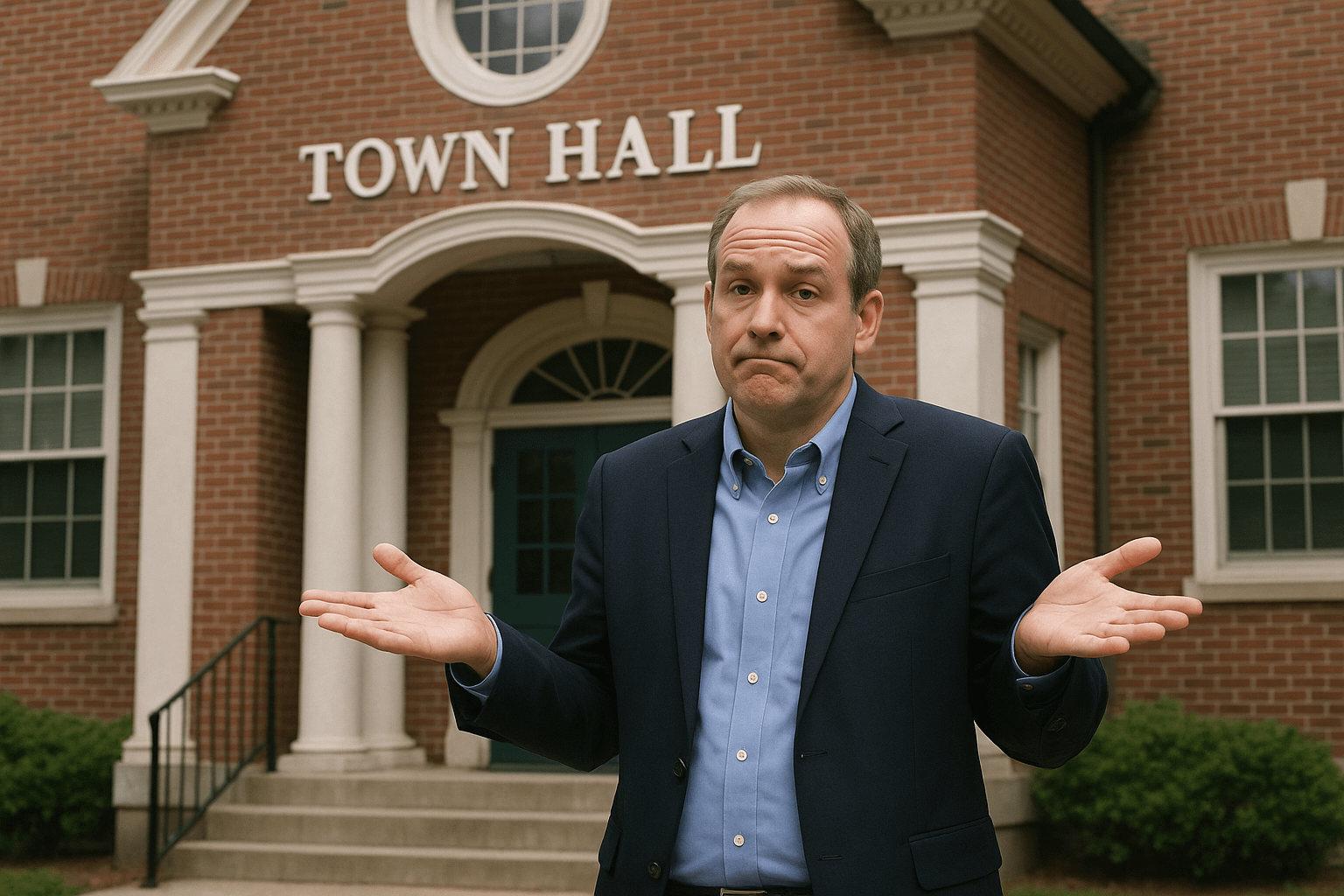

The corrosion of trust doesn’t start in Washington – it starts at the town hall…
My town, where I’ve spent all but a few years of my life, is still a town. We’re not a city and we don’t have councilors or representatives. We hold Town Meetings, vote on articles as individuals, and have the opportunity to speak to our government and the town directly – this isn’t representative democracy, it’s direct. But we still have politics.
We can’t have votes every week, so of course we have our Boards and Committees to shoulder the burden of day-to-day logistics and decisions. They’re comprised of local leaders, residents whom sought their positions from a selfless desire to serve all of us within the town.
Whether a town or a city, local government should serve to embody the purest expression of our democracy. It is, after all, the arena closest to the people… the place where neighbors elect neighbors, and where decisions made on Main Street ripple directly into the everyday lives of the residents. Aristotle himself would have recognized this closeness: in the Nicomachean Ethics, he argued that politics is not some abstract game of power but the practice of cultivating the good life in community.
Government, when viewed in this light, is not just some mechanism for rules and enforcement, it’s an ethical function of our society. It demands leaders who see their responsibility as a form of stewardship: to deliberate with reason, to act with virtue, and to safeguard the well-being of the community entrusted to them. And sometimes this may mean championing a cause in opposition to their own interests or sensibilities.
Yet here in Middleborough, Massachusetts… my hometown, where I was born and raised… we have the perfect representation of how, sometimes, reality could not feel further from that ideal.
A Case Study in Neglect
They say experience is the best teacher, and lessons in ethical leadership are no different. The whole idea for this article came about because of observations and experiences in our local government. It centers around finding the balance between competing needs of a scrapyard and residents, and the breakdown of ethical leadership in town.
Since March, residents in this part of town have been raising alarms about the scrapyard. Complaints that their neighborhood is rocked with explosions and the machinery reverberates through their foundations and homes located less than 1,000 feet away from the near-constant industrial noise. When they discovered the source was this new shredding equipment, they followed the rules and notified the local Board of Health (a role fulfilled by the Select Board of the town). State law is clear: once the Board of Health becomes aware of a public nuisance, it has a statutory obligation to address it. This should be an ethical given, but we all know what is said about commonsense.
The yard had been operated for more than 60 years by a local family until being sold to new owners. And those new owners were undoubtedly interested in improving the efficiency, scope, and (likely most importantly) revenue of their new investment. There is just one caveat and challenge to this business’ location; it abuts a residential neighborhood. But prior generations of ethical local leaders saw this potential conflict and provided recourse for resolution through specialized zoning bylaws. They recognized that virtue in governance requires not passivity but foresight.
Yet, over the span of six months following that initial notice to the local authorities, not a single public meeting was held. The town manager flatly refused to act. And the only progress came when residents, tired of waiting, bypassed local government altogether and appealed directly to the state for assistance.
The state eventually did what the town would not: it confirmed that the nuisance existed. One might think that acknowledgment would force the Select Board or the health department to move decisively and rectify the situation. Instead, the town’s health department (separate from the elected board in its obligations) allowed the scrapyard to continue operating while the business drafted a proposed plan to manage the noise generating the public nuisance. The residents again took a backseat to the business, without recourse and without debate.
The proposed solution from the business was to erect a barrier, built from shipping containers, and filled with tires to act as sound-deadening. These barriers were no modest correction. They were hundreds of feet of end-to-end, double-stacked, containers piled on graded soil and asphalt millings. And similarly to every other aspect of the local government’s handling of this situation; they were constructed with no building permit, no zoning board approval, and no public oversight.
When questioned about the lack of permitting and approval, the local Code Enforcement Officer offered an explanation that would be laughable if it weren’t so revealing: “It’s temporary and (I determined) it does not require a permit.” Pressed further on how such a massive structure could possible qualify as temporary, he replied, “They could take it down in a few weeks or months for all I know. I don’t know that it’s going to be there forever.”
This reasoning collapses under even the most basic scrutiny… The business constructed the barriers to mitigate noise at the direction of the Health Department. The source of the noise has been operated by the business for years. They’ve invested considerable resources to build a container wall to comply. And yet, officials expect a reasonable person to believe that after all of this time and expense, the scrapyard might simply dismantle both the equipment and the wall in a matter of weeks.
To accept that logic is not only to abandon reason, but to ignore and excuse inaction. It is the epitome of governance that has been reduced to shrugging.
The Town’s Ethical Burden
“The good of the individual is desirable, but the good of the city is a greater and more perfect thing to attain and preserve.” (Aristotle, Nicomachean Ethics I.2)
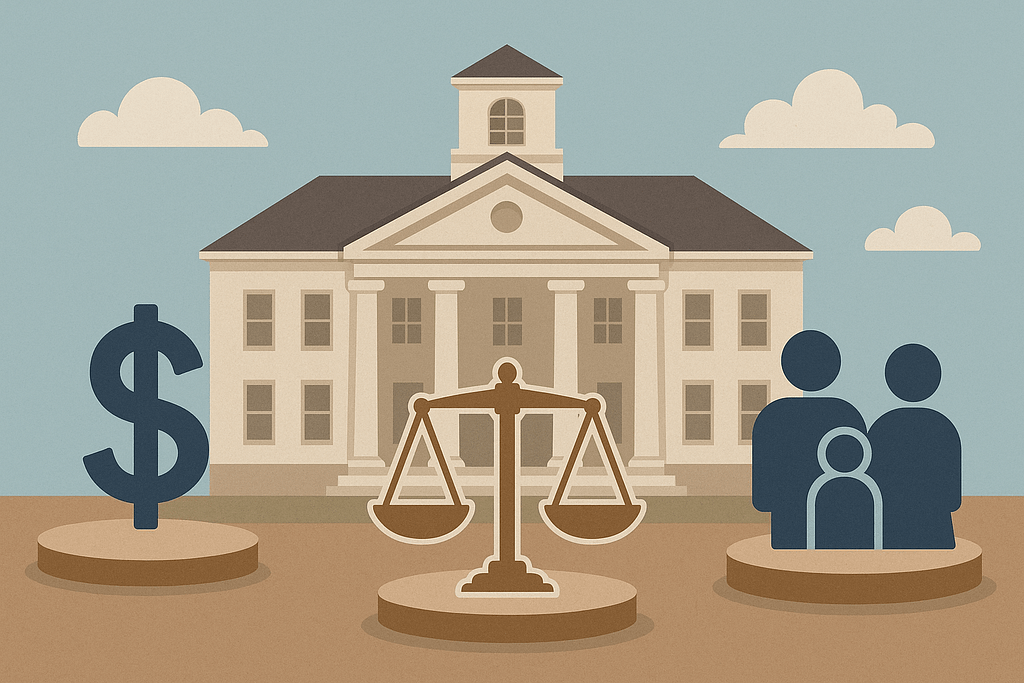
To truly understand this case, and to appreciate the ethical obligations it exposes, you have to see it clearly: there are three parties at play.
The first is the business. Businesses, by their very nature, will seek out more efficient ways to operate, to grow, and generate higher revenue. The scrapyard purchased new equipment because it promises efficiency and profit. Just like the scrapyard, the developers who built the homes behind the scrapyard secured and developed land they were legally allowed to build upon. In both of these cases, the businesses acted according to their natural goals. Aristotle would call this their telos: the pursuit of their proper purpose. While it may not always produce harmony, it is not unethical by itself.
The second party to the case are the residents. They purchased those homes seeking to enrich their lives, raise families, and secure a place of peaceful enjoyment. That is what residents in a community do. They, too, acted in pursuit of their natural end: ‘the good life’… safety, stability, and community.
Neither the business nor the residents committed a breach of ethical conduct. One sought profit, the other sought peace, but both acted within the reasonable scope of their roles.
The third party, and the one with the true obligations to finding our eudaemonia – our harmony – is the town.
Here is where the problem shifts from one of conflict to failure. In Plato’s Republic, justice is defined as each part of the city fulfilling its proper role. For government, that role is neither profit nor private enjoyment, it is the stewardship of fairness and order, and reconciling competing needs so that neither overwhelms the other. Following Plato, Aristotle taught that the aim of politics is the common good, achieved through phronesis – practical wisdom – and applying this wisdom in the resolution of conflicts.
Read more about these in our article on Toxic Leadership
And here, Aristotle’s teachings of the mean is truly instructive. The mean, to Aristotle, is that point between extremes. This space is where we find virtue… courage between cowardice and recklessness, justice between favoritism and neglect. In the case of the scrapyard, the extremes were clear; on one side, an unchecked industrial intrusion; and on the other, an unrealistic expectation that business cease to exist altogether. The town’s duty was to deliberate and find the virtuous mean. This would be a balance that preserved both economic vitality and residential peace.
Assuming motivations of personal gain were not in play, the town instead chose the cowardice of avoidance. It mistook silence for prudence, and in doing so allowed one extreme – the business’s expansion – to overwhelm the other. Avoidance isn’t wisdom, it’s cowardice, and cowardice is most certainly not a virtue.
It was the town leader’s responsibility to approve the development of the homes, and of course, there was no zoning bylaw to forbid it. If immediately required, it was the town’s responsibility to review the scrapyard’s new machinery to ensure its use fit within its grandfathered status. On the surface, it appeared permissible. But when nuisance complaints came, the ethical and legal mandate was unmistakable: investigate, deliberate, and mediate equitably between residents and business.
Instead, the Select Board chose to do nothing. Worse than nothing, it obstructed. It placed barriers in the path of residents, and it bent rules to accommodate the business. The very leaders tasked with adjudicating equity and reason did not merely abdicate its duty – it perverted it.
This is the exact opposite of Platonic justice and Aristotelian virtue. Where the business pursued profit and the residents pursued peace, the leaders of government should have pursued the mean – balance, fairness, reasoned governance. Instead, it chose comfort and vice: cowardice dressed as neutrality and silence disguised as order.
To call this an ‘abandonment of duty’ doesn’t really capture the scale of failure. It’s like calling a hurricane a ‘stiff breeze.’ This isn’t just inadequate, this kind of leadership failure is an ethical bankruptcy.
When Principles Are Convenient
This case isn’t an isolated failure. It is part of a larger pattern in which this Select Board has elevated convenience and self-interest above principle.
Earlier this year, the board voted unanimously to support a town exemption from the state’s new firearms control measures. In the interest of transparency, I too, supported that outcome. But the troubling part wasn’t their support itself – it was apparent lack of reasoned deliberation behind it. We heard from other members and residents regarding the constitutional basis of support, the historical context for dissent. But the Select Board’s decision fit neatly into what is a broader history of board members acting not on ethical grounds, but on whichever measures best served their own preferences.
Compare that to last year, when a resident proposed a restriction on heavy truck traffic in a residential neighborhood. Instead of debating safety, infrastructure, or fairness, the Select Board and the police chief claimed such a restriction might be unconstitutional. The assertion was so patently absurd that it would be humorous… if only it hadn’t been used as a rationale by government officials.
These episodes illustrate not just bad judgment, but a fundamental failure of deliberation. Looking back to Aristotle’s phronesis, or practical wisdom, it’s the ability to apply moral reasoning to particular circumstances. What we consistently see is not wisdom but arbitrariness, and not reasoned governance, but a casual expediency.
The Erosion of Standards
Government without virtue is no government at all – it’s obstruction dressed in authority.
This rot extends beyond individual votes and decisions. It is embedded in the very culture of how officials conduct themselves.
Public comment is too often treated as an inconvenience. Citizens who voice disagreement are met, not with thoughtful counterarguments, but with rudeness and disdain. One member went so far as to refer to a local volunteer resident as a “terroristic threat” simply because that resident dared to raise concerns in another meeting about town silence on water contamination levels. That is not debate, that is intimidation, and it’s wholly unworthy of a public official.
Nor is this culture confined to the board alone. At that same public session, a Water Superintendent, confronted with his own inaccuracies in describing water quality as “blended” – became flustered and announced, astonishingly, that rather than educate himself (and the public) on the true definitions, he would simply stop using the terminology altogether. This is not leadership, it is certainly not service… it is nothing more than ineptitude masquerading as authority.
Such moments are not minor slips or brief lapses that are easily recovered and remedied. These eat away at the basic expectation that government officials are supposed to rise above pettiness, ignorance, and hostility. Holding office requires patience, humility, and the willingness to learn. What we are seeing instead is arrogance, evasion, and contempt for those who ask fair questions.
It is a betrayal of the ethical obligations of public office.
This is where Aristotle’s insights feel eerily modern. He warned that when leaders pursue their own advantage instead of the common good, politics degenerates into corruption. Government ceases to be a shared enterprise and becomes a tool for private ends. The Select Board’s silence in Middleborough is not neutral – it is itself a form of corruption, because it betrays the obligation to deliberate openly, rationally, and for the benefit of all.
Why This Matters Beyond One Town
It might be tempting to dismiss these failures as “small-town politics”. To chock them up to a blend of gossip, grudge, and backroom handshakes, but that would be a mistake.
The health of local government matters precisely because it’s local. This is where democracy is a lived experience. When people lose trust in their local government, they don’t just lose faith in one institution, they lose faith in governance itself. Cynicism in government starts at the town hall and it spreads outward. If we allow the elected leaders in our neighborhoods to ignore their obligations, how can we possibly expect state legislators, governors, or members of Congress to behave any differently?
Democracy doesn’t collapse all at once. It frays in increments: every shrug, every delay, every evasive answer that replaces genuine deliberation. They all serve to alienate the voters, to cause them to truly believe that their voice has no merit, no value.
When we look into election turn-outs, it’s no wonder that most voters only show-up during presidential cycles, or why there is such an extreme divide between political ideologies. We feel powerless on the local level. Local candidates run unopposed or are voted in by 4% of the electorate. Citizens lose hope in an improved situation and they seize the idea that the most powerful elected officials may somehow improve their way or quality of life. That somehow the President or members of congress may make their life better.
This is not to say that Federal politicians don’t affect us – they absolutely do. But their level of impact on our day-to-day lives pales in comparison to the effect our local leaders wield in our cities and towns.
A Call Back to Common Sense and Virtue
So how do we fix the broken leadership where we live? The answer is not complicated, nor is it partisan. It’s common sense: local leaders must be held to a higher standard – not only because the law demands it, but because the health of our civic life depends on it.
Aristotle reminded us that virtue is not abstract, it’s formed by habit. Leaders become just by doing just things, courageous by doing courageous things, they become temperate by practicing temperance. Likewise, our boards, councils, and committees become virtuous only by practicing virtue. That means deliberating openly, with honest reasoning, and acting in the interest of the community as a whole.
My own town’s leadership has failed to do this. It has failed to meet even the most basic standard of public responsibilities. And the result is not just frustration over scrapyards or truck traffic. The result is the erosion of trust in the very idea of government.
But there is always a way to improve, as long as there are those willing to act. Good leaders emerge – they question, they critique, they demand answers. Good citizens show up – they educate themselves, they leverage the mechanisms that exist to restore accountability. Things like open meeting laws, public records laws, or citizen petitions. Because American government is not for the political leaders, nor is it for any political party, it is for the citizens – it is ours – and even if it’s languishing under an ethically broken leadership… they’re only borrowing it. We can start fixing it anytime we’d like, we simply need to get involved.
Restoring Faith in Government
Political parties and leaders that move their bases to action through catchy slogans can certainly rally a vote, but faith in our government is not restored by speeches or slogans. It’s restored when citizens see their leaders act ethically; with integrity, transparency, and courage. We revive our faith when boards deliberate in public, officials explain their reasoning with respect, and when records are shared openly rather than hidden behind firewalls and bureaucratic red-tape.
This isn’t a utopian idea, this is the baseline of what a healthy democracy demands, and it doesn’t begin in Washington or in some capitol city like Boston… it starts in ‘Anytown’, just as it starts here – at the Select Board and committee meetings in Middleborough, Massachusetts.
If government is going to mean anything, it has to be held accountable, and accountability begins at home.
Aristotle established it: politics is ethics, just scaled for the community. When our officials forget that truth, they don’t just fail to govern, they corrode the foundations on which governance rests.
This is the drive of Cardinal Tenets, we’re here to inspire a return to ethics and reason – to commonsense. To that end, we need to demand more: more reason, more virtue, more integrity and honesty… In every community where government has seemingly forgotten its purpose.