

Tools of the Trade or Trials by Fire?
In today’s business world, technology is part and parcel of everyday life, and unfortunately often seen as a cure-all by some business leaders. From AI-driven chatbots to workflow automation, companies are in constant pursuit of efficiency, scale, and competitive advantages when it comes to tech adoption. All too often though, that pursuit forgets one of the most critical components of success… and that’s the people who are expected to use the new wonder tool – the ones who will feel its impact the most.
Whether in operations, customer experience, or partner support, technology stands to be transformative… or tormenting. The difference can almost always be found, not within the tech itself, but in how and why it’s implemented.
The Human Cost of a Bad Rollout
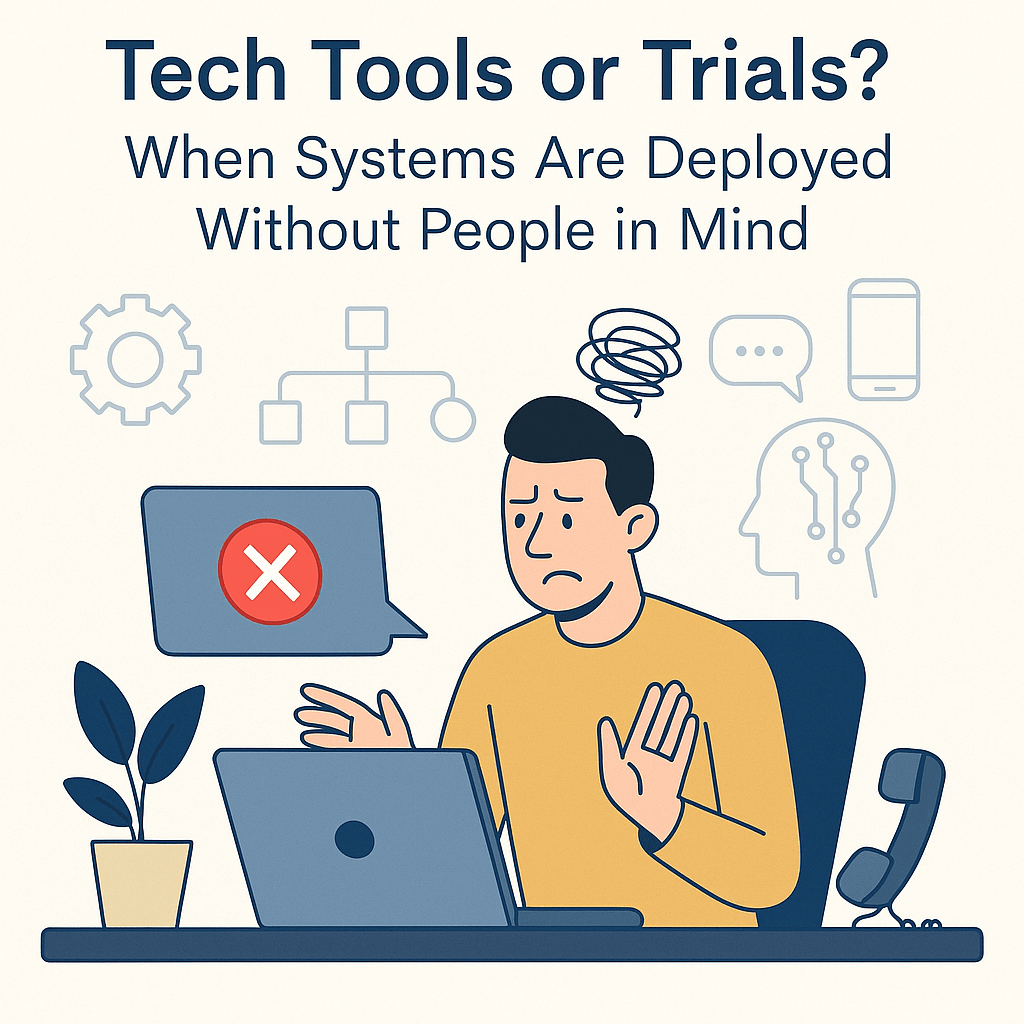
Ask any employee and there’s a very god chance that they’ve had some exposure to this shared experience; a new system suddenly appears with minimal explanation, no training, unclear purpose, and no apparent relevance to the daily tasks that it’s supposed to be “improving.” When new technology is debuted in this manner, it’s viewed less as an improvement and more an an imposition.
Poorly deployed systems don’t just fail to solve a problem, frequently they create new ones. Employees become frustrated, customers become alienated, and vendors or partners waste precious time navigating interfaces that were designed without their input. Worse still, frontline staff are often left to just “deal with it” while the decision-makers rarely feel the ripple effects.
Beyond the financial hit, the morale slump, and the time it takes to roll out, businesses lose the very benefits this tech adoption was supposed to bring.
Start With Ownership, Not Just Software
Before any tool is introduced, organizations must engage in one essential act: process analysis. Not just what the process should be, but diving into what that process really is. Identifying who owns each step, what the pain points are, and determining which process description is closest to the reality.
In every technology or process change, genuine stakeholder engagement is essential, not just a nice-to-have. That means talking to the frontline employees, not just the department heads. It means involving the actual users in decision-making, instead of just rolling out new systems “on their behalf.”
Tech adoption without user buy-in is like remodeling a house without consulting the people who live in it… Check out Trading Spaces from the early 2000’s to see how well that works.
This approach and advice isn’t just some operational wisdom, it’s philosophical too. Aristotle reminds us in Nicomachean Ethics that we cannot know the good in abstraction. As in, we can’t appreciate something by just looking at random selections that fail to offer a true representation. The practical good needs to be understood through the lived experience of those in the polis (the community). Likewise, what is “good” for a business cannot be known from the boardroom alone. It must be known through those who live its processes every day.
Don’t Forget the People on the Edges
Every tool or decision affects more than just its primary users. A new back-end CRM might impact how quickly a rep can respond to a customer, but create a bottleneck for other employee groups because of their own outdated system limitations. A flight scheduling system might improve efficiency on paper, but wreak havoc on staff or crews at the airport-level.
At our airline, we’ve seen this firsthand. A scheduling decision was made to maximize operational efficiency and generate revenue on repositioning flights that would otherwise have gone out underutilized. From a planning perspective, the change was logical, commonsense even.
But one critical piece was missing: communication with the polis.
The support desk and airport staff and leadership weren’t consulted prior to rollout. The change triggered a schedule update for the same week, unexpectedly extending work hours for frontline staff by over two hours. One employee, overwhelmed and blindsided, nearly resigned on the spot. They weren’t part of the planning team. They had no say in the decision, and yet they bore the brunt of it.
Fortunately, the staff raised the alarm early. The concerns were escalated, and the flights were moved back into a non-revenue state. Attrition was avoided, but only barely.
This is exactly what happens when adjacent users are forgotten. These are the people who don’t sit at the project table… but who still feel the full impact of the choices that are made.
We saw this again in the implementation of new crew scheduling software, a project forced through by senior leadership without consulting the end users who would depend on it daily. Instead of improving operations, it multiplied the manual workloads of frontline scheduling staff, slashed efficiencies, and drove employees to invent workarounds just to keep the system afloat. Shortcomings were raised again and again, but ignored as leadership defended the investment and the developers behind it.
For years, the project limped forward, consuming hundreds of thousands of dollars and immeasurable hours of staff time… even as complaints, warnings, and attrition piled up. Only this past year was the relationship finally severed; and after all the turmoil, wasted resources, and turnover, we ended up right back where we started. Leadership hubris had carried the project farther than reason ever would have, and everyone paid the price.
For more insights, check out our article on Toxic Leadership…
It’s not just about logistics – it’s about ethics.
In The Republic, Plato talks to us about leadership requiring awareness of the whole. Decisions made in isolation, without regard for those affected, lead to injustice, even if the intention is good. Practical wisdom (phronēsis), as Aristotle would argue, requires that we consider not just what we do, but how those decisions and actions affect those around us.
Any decision or rollout, needs to look beyond the primary user. Because experiences aren’t often contained to the system, they ripple outwards to the people who live with the consequences.
Communication Is the Real Accelerator
If a new system is going to succeed, the rollout must begin not with code, but with clarity. Change should be framed with purpose. People need to know why it’s happening, what problem it’s solving, and how it’s supposed to work in their environment. They need to understand how it will impact them and others, and what the support structure looks like going forward.
Training is absolutely necessary, but it is not enough. Context is everything and people have to be brought into the conversation, not just focusing on the software.
A well-communicated change can win over skeptics. A poorly communicated one can turn even the best tools into immediate failures; rejected even before the deployment date. Communication builds buy-in, it turns change from something done to employees into something done with them.
And it helps prevent the dreaded double-whammy: when an employee is not only frustrated by the system… but is then faced with irritation by customers or colleagues equally frustrated by that same system.
Trickle-Down Tech Failure Is Real
There are few guarantees in organizational life, but this is one of them: if a system frustrates the user, it will spread. It trickles down and outward. It shows up in employee disengagement, reduced customer satisfaction, and longer lead times. These frustrations erode patience and undermine everyone’s faith in leadership.
And when people stop believing that leadership understands, or even cares about, the real-world consequences of their decisions, you’re losing more than productivity, you’re losing trust.
Technology Is Not a Shortcut – It’s a Relationship
The temptation to chase the “next great platform” is extremely strong. But no technology can fix a broken process or a disconnected team. Tools are amplifiers. They enhance what already exists, whether that’s dysfunction or cohesion.
Tech adoption, just like leadership, must be ethical. It needs to consider the impact on people, not just performance. And it has to be implemented with reason and balance, the virtues that guided Plato and Aristotle’s ideal society.
As Plato teaches, governance (and leadership) is not about control, but about creating conditions where justice, the right order, can flourish. In modern terms, that means systems that make life better, easier, and clearer for those affected by them.
Ask Before You Install
Before your organization deploys a new technology, ask whether the problem being addressed is the right one, and whether the right people have been involved in identifying and solving it. Consider whether the change has been communicated clearly and whether its impact on everyone, including those people on the edges, has been acknowledged. Most importantly, ask if this new tech adoption will truly serve the people it touches, or just serve to frustrate them.
Technology is a tool, a powerful one, but like any tool its success is not guaranteed. I depends not on what it can do, but how well we’ve prepared the people who are going to use it.
Because a hammer in skilled hands builds a house.
In unskilled hands? It just breaks things.