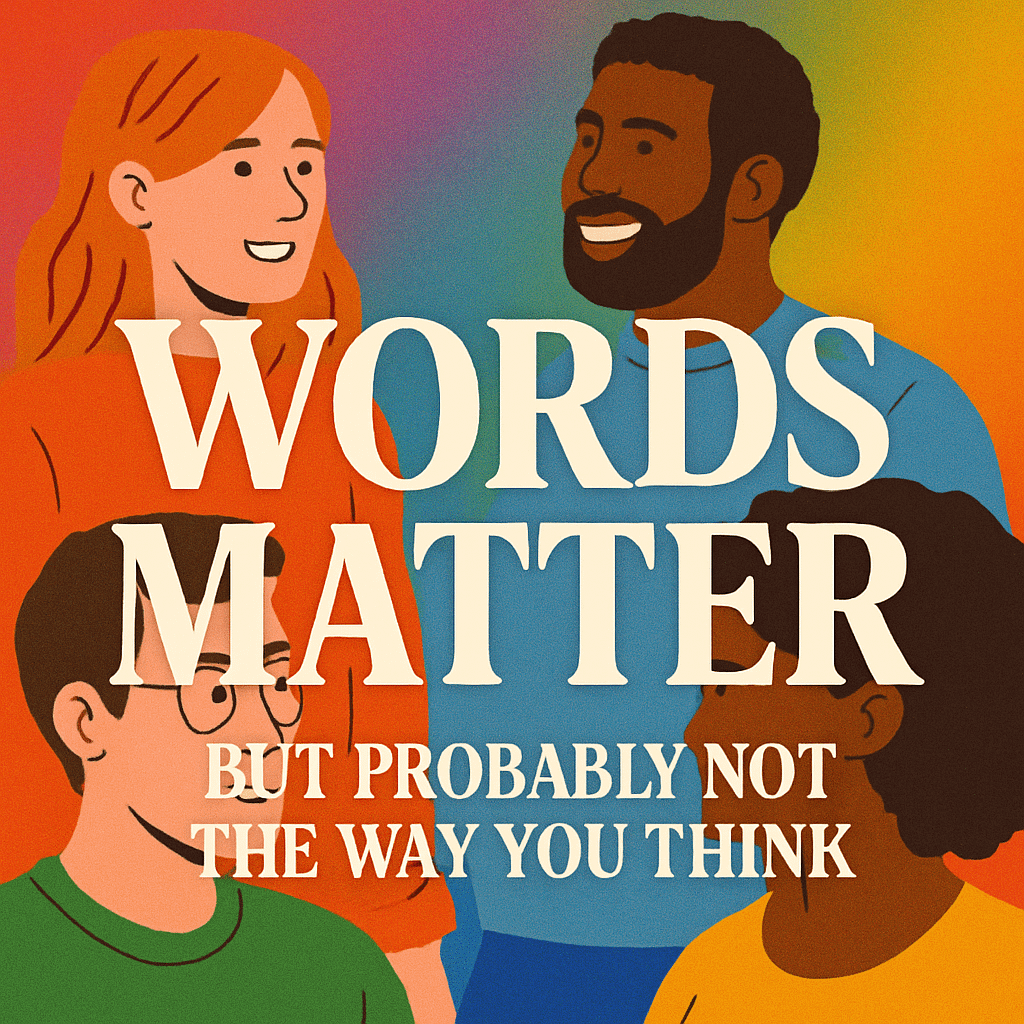

We’ve all heard the phrase ‘words matter’, it’s been etched into social media bios, pinned onto corporate mission statements, and spoken with sincere conviction whenever a public figure fumbles a line in a speech.
“Words matter.”
To be clear: they absolutely do, but we really need to talk about how and why they matter today. We need to look at how we’re weaponizing this concept, how we’re policing it and considering this idea. Because it seems to have taken us further away from truth, not closer to understanding it.
When we say “words matter,” rarely is it meant in the pursuit of clarity or growth. More often, it’s meant as a warning or rebuke, it’s become a tool to silence rather than means to understand.
In an attempt to guard ourselves from harm and offense, we’ve begun to strip our language (and along with it) our dialogue, of its grit, context, and power to reveal the things we don’t always want to confront.
This isn’t progress; it’s almost a kind of linguistic paralysis.
When We Say “Words Matter,” What Do We Actually Mean?
On its face, the idea is simple and true; I don’t believe anyone would argue the point that words are important and the ones we choose really matter. After all, they carry weight and can either encourage or erode – heal or harm. They shape our perceptions of situations, and they can influence the action we take. They matter a lot, not only which ones we use, but how they are used.
But over time, we’ve turned that truth into a type of orthodoxy. We exist in a climate of rigid doctrines where any deviation from the “correct” word is taken as evidence of a moral failure. We seem to live in an age where intention no longer matters. This universe where missteps are met with scorn, instead of a desire to understand and learn.
And that right there, that is a problem. We cannot hope to have real progress, or real learning, hiding in fear from uncomfortable feelings. Learning, progress, growth… they come from a place where conversation, especially the messy and uncomfortable kind, can be had openly and respectfully.
As Aristotle warned in his Nicomachean Ethics, virtue lies in the mean – the balance between extremes. In speech, just like in actions, we can find ourselves failing by being either too reckless or too timid. Courage, though, that is the midpoint between cowardice and rashness; and just like courage, somewhere between our cruelty and silence, we can find clarity in our conversations. We can help each other understand more.
A Word About Words: “Retarded” and the Rebound of Offense
Recently, a report highlighted the continued, and growing, use of the word “retarded” to describe something foolish, unnecessary, or absurd. As someone who grew up in Massachusetts, I’m not all that surprised. I’ve heard the word used that way my entire life.
But there’s an uncomfortable truth here: the problem isn’t the word. The problem is how we think about it.
I want to be very direct in my words here… “retarded” as a medical descriptor is no longer acceptable. It has a history of ties to exclusion, mockery, and dismissal of people with intellectual disabilities. But the current usage, especially among younger generations, has morphed into something else entirely; its current use is far more thoughtless than it is malicious.
Herein lies the nuance we seem to gloss right over: the people using this word in a casual, offhanded, or even comedic way often aren’t attacking the disabled. In fact, they’re usually not thinking about the disabled at all. That’s not meant to invalidate anyone’s offense to it, it’s an observation of the speaker’s likely intention.
And intention, as Plato talks about in his dialogues, is central to our understanding of human behavior. In The Republic, we’re warned not to judge merely by appearances or emotional reactions, but to go deeper and seek what is really true; we’re compelled to ask what lies underneath the surface. If we just start condemning people without first questioning their intent, we have failed to engage in philosophy’s first and most import task – the pursuit of understanding.
Ignorance Isn’t Always Malice. That Cuts Both Ways
There’s ignorance on every side of the modern speech wars, we’re human, and no-one is innocent from some form of ignorance.
The person using an outdated or offensive word? Yes, they are ignorant… they may lack empathy or awareness, or maybe even both. But to the person hearing it… if that person immediately jumps to an assumption of hatred where there is none, they are equally ignorant, because they have failed to appreciate the speaker’s frame of reference. This is very much a case of ‘two wrongs, do not make a right’.
As Plato might put it, we’re seeing shadows on the wall of the cave and assuming they’re monsters, rather than seeking the light of real understanding.
Language is constantly evolving, yes, but the human nature has always been to repurpose, simplify, or co-opt. We don’t need to look far beyond the ‘r-word’ to find plenty of other examples of, once-clinical, labels that became pejorative by cultural repurposing… Idiot… Moron… Imbecile… Cretin… Feebleminded.
Each one of those started out life as a “correct” term. And then each became corrupted and outdated from its original purpose. After falling victim to new and diminutive uses, they were replaced by a new word, and typically these new words only last so long until they too are repurposed… and the cycle repeats. This isn’t some kind of a morally failing society, it’s just the reality of humanity’s linguistic nature.
If we are legitimately interest in growth and progress, then what we should be doing is asking why people speak the way they do, and interrogating our own perceptions against the immediate desire for the behaviors of others to change. We say that progress and knowledge are important, if we honestly believe in those principles, then we should stop trying to silence language so reflexively.
As a Gay Man, I Could Spend My Life Offended
Let me say this plainly: I’m a gay man. There are plenty of words used to identify people in this community, and I’ve heard plenty of those words used as a joke or out of ignorance. Yet every time, I remind myself that it’s important to understand the intent behind the word, and it’s an opportunity to have a conversation.
But in my life, I’ve only once had a derogatory gay slur hurled at me where it was truly meant as an attack. And here’s the real irony: that word could have been almost any word. Because it wasn’t the slur that mattered, it was the intention behind it that made it sting. That intention is what gave it power and that’s what made it hurt.
My grandmother would say, “I don’t like being called ma’am, I’m Linda. In my life I have heard people say ma’am in some of the nastiest, meanest, ways. Just because you use a nice word, doesn’t mean you’re being nice.” I have always felt this was the simplest and easiest way to explain it. Nice words, used cruelly, are no longer nice words.
And that’s because words alone don’t carry hate. Hate carries itself just fine on its own, and it will find any word it needs to convey the message.
If I took offense every time someone said something that didn’t align with my personal worldview or comfort, I’d have no time left to focus on the things in my life that actually matter.
Instead, I’ve learned to ask two very simple questions:
- Are they trying to offend?
- Or are they just talking… imperfectly, ignorantly, but at least honestly?
More often than not, it’s the latter. I love the later, because that opens a door.
But be warned, there’s a catch on this door, because for someone to learn, they have to be receptive; and people don’t stay receptive when they feel attacked. They almost immediately shut down – they’ll retreat and double down.
Just like a real door, when someone opens it for you, don’t rush inside blowing past them or mock them for having opened the door in the first place. Consider your own responses, how will you be perceived if you launch headlong into the role of ‘teacher’. If that is your tact, there’s a very good chance that this person will (at least subconsciously) feel ‘less-than’; because when someone has to educate you about something that you didn’t know you needed to learn, the innate human reaction is to feel inferior. It is a bad feeling, and if you’re not prepared, it can be humiliating.
Getting back to those intelligent Greeks, Aristotle taught that learning requires phronesis or practical wisdom. That wisdom is rarely (if ever) achieved through humiliation. You get there through cultivated dialogue, experience, and grace. So when that door is opened, don’t be a teacher, be a friend, a peer, an equal. You’re not teaching, you’re sharing.
Kindness Is Not Weakness. It’s Precision
If we want to change minds and hearts, we can’t just go and drop the hammer. We need to offer that hand.
This isn’t to mean that we just let hatred off the hook. What it does mean is that we distinguish between those who harm because they want to, and those who harm because they’ve never been understood a different way.
When someone says something offensive, the most powerful question we can ask isn’t “How dare you?” It’s “Why did you say that?”
And if the answer is ignorance, we don’t need to shame them. We need to talk with them.
That’s hard work, but it’s the only way anything changes.
Let’s Speak Plainly and Listen Honestly
“Be kind, for everyone you meet is fighting a hard battle.” – Ian MacLaren
Words matter, but clarity matters more, and intention matters even more than that. But don’t forget that, at the end of the day, growth matters most… after all, that’s our goal.
If someone is being cruel, it should be corrected. But we should not confuse every offense with some kind of oppression; and we should not make speech itself the measure of our morality.
To quote Scottish minister Ian Maclaren, “Be kind, for everyone you meet is fighting a hard battle.”
And in that spirit, let’s remember that the point of language isn’t to trap each other, it’s to help understand one another. A hammer is a useful and productive tool, but used inappropriately they become weapons. We need to stop weaponizing our language if we hope to get back to building.
So after all that, yes, words matter, but meaning matters more.
Let’s learn to speak with clarity. Then stop, so we can listen with courage. Finally, stop again, and think on how to lead with wisdom.